How to Read a Southern General Store as a Main Street Landmark
Learn how to read a Southern general store as a Main Street landmark by spotting its building clues, traces of trade and signs of community life.
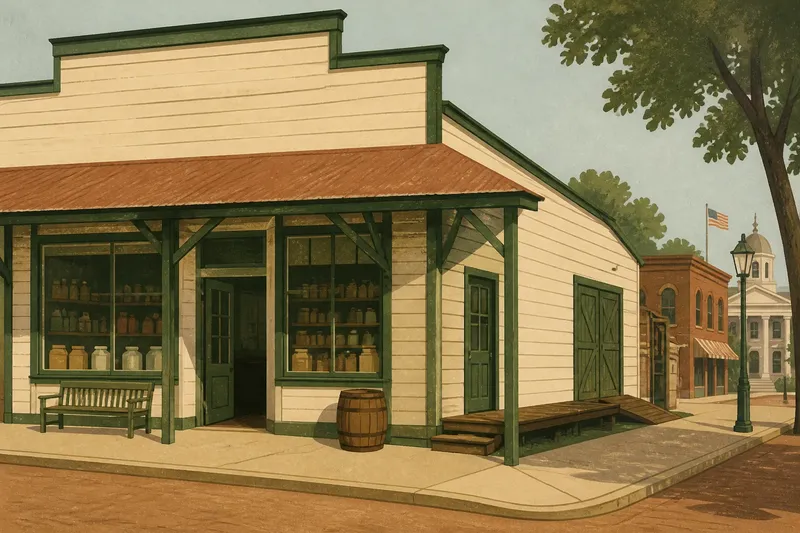
A Southern general store becomes a Main Street landmark through the ordinary exchanges that keep drawing people back. To understand a Southern general store as a Main Street landmark, look first at its setting and working details, then at the trade and conversation around it. The aim is not to decide whether a shop is “authentic”, but to understand what it has meant to its town and what it means now.
Start with the setting
Before looking at the sign or the merchandise, take in the store’s place on the street. Is it near the courthouse, beside a crossroads or close to a former rail stop? Does the pavement lead directly to its entrance, or do people approach from a gravel lot or side road? These relationships help explain how the store fitted into daily journeys.
Notice what stands nearby: a post office, church, feed shop, barber or the remains of a loading platform. A store among other everyday destinations might have served people combining errands. One at the edge of a small settlement could have been a stopping point for households spread across surrounding farmland.
Keep the first impression modest. A faded painted sign can be suggestive, but it does not establish the building’s whole history. Separate what you can see from what you would need to ask a local archivist or long-time resident.
Read the building
Look at the structure as a record of changing use. A broad front entrance may have welcomed customers carrying sacks or parcels; a side door could have served deliveries. Large windows make goods visible from the pavement, while a covered awning gives people a place to pause out of the sun or rain.
Check for alterations without treating them as damage. A blocked doorway, newer shopfront or patched siding may mark a change in ownership or purpose. If the building now houses a café or local-history room, its current layout may preserve traces of the shop while making room for a different kind of gathering.
Notice the building’s scale in relation to the street. A plain timber store can be as locally significant as an ornate landmark: its importance may lie in being a familiar shared address rather than an impressive façade.
Follow the trade
General stores were practical places, and their stock reflected what customers needed close at hand. Shelves might have held dry goods, tools, household supplies or farm necessities; a counter gave buyer and shopkeeper a natural place to meet. The exact mix varied with local needs, transport and nearby businesses.
Look for visible traces rather than assuming every old store sold the same things. A high service counter, broad shelving, storage space or a rear loading area can prompt useful questions. If the premises remain open, ask about its present role and whether any features have been retained. If it is closed, exterior details can suggest how people and goods moved through the space, though they cannot settle every question.
Say you are standing outside a former store with a wide front window, a side entrance and a delivery door at the rear. You note each opening, then compare them with a town photograph or ask a historical society whether they served customers and deliveries in separate ways. If a photograph or account supports that reading, you can describe it as evidence; if not, keep the purpose uncertain. The result is a more grounded account without turning a plausible guess into fact.
Notice the gathering
Trade was only part of the store’s town role. A customer waiting at the counter could hear who had come in from a neighbouring road, what was happening at the church or when a familiar family might pass through. News travelled in small exchanges, not as a formal bulletin.
Look for places where those exchanges could happen: a bench, a wide threshold, a counter facing the door or a patch of shade just outside. These details suggest a store that allowed people to linger as well as buy. They do not prove what was said, but they help explain why the address might have become a social landmark.
Ask how the gathering worked in practice. Did people arrive on foot, by car or after work? Was the shop a quick stop, a regular meeting point or both? Residents may remember it differently; that variation belongs in the town’s story.
Trace the changes
Compare what the place does now with traces of earlier use. It may still sell everyday goods, serve as a café, house a community display or stand empty while the town considers its future. “Landmark” need not mean unchanged: a building can remain part of local memory after its original business has gone.
For a clear account, work through these observations. Each one should lead to a decision rather than an unsupported conclusion:
- Check the street location and nearby civic or commercial places. If several destinations are close, describe the store as part of an errand route; if not, note its more isolated setting instead.
- Check the entrances, windows, awning and loading access. If a feature is visible, record its position and appearance; if it is absent or obscured, leave its former use unresolved.
- Check the building’s present use. If it is open, describe what happens there now; if it is closed, record only what the exterior shows.
- Ask a resident or local history group about changes in ownership and purpose. If accounts agree, report the shared recollection as such; if they differ, preserve the disagreement.
- Check photographs, directories or town records against each claim. If a source supports the detail, identify the source in your notes; if it does not, keep the claim tentative.
- Check each detail for uncertainty. If it is directly visible or supported by a source, state that basis; if it is an inference, label it as a possibility or omit it.
Imagine you are looking at a former store with a front window, a side entrance and a rear door, and you want to describe how it handled customers and stock. First, note those three visible features and their positions. Next, compare the building with an old town photograph, then ask the local historical society whether its records identify the rear door as a delivery entrance. If the photograph and record support that explanation, describe the separate routes with those sources noted; if they do not, say only that the doors could have served different purposes. Either way, your account distinguishes what you saw from what you could establish.
A local library or historical society may point you towards photographs, maps or business directories. Records can place a store in a wider town history, while oral accounts often explain routines that paperwork leaves out.
Questions about stores?
What made a general store different from a grocery?
The term generally described a shop carrying varied necessities rather than specialising in one kind of goods. The precise stock depended on the town and the store’s period of operation, so local evidence matters more than the label alone.
Why did stores become gathering places?
They brought customers and shopkeepers into repeated contact around useful errands. A counter, doorway or shaded spot nearby could make brief visits into opportunities to exchange news.
How can I check a store’s local history?
Try the town library, historical society, local newspaper archive or a directory collection. Ask residents specific questions about what they remember, and distinguish personal recollection from details supported by records.
Can a former store still be a landmark?
Yes. A building may remain a recognisable meeting point or a store of shared memories after its original trade ends. Its present use and the community’s attachment help explain its continuing place on Main Street.
Leave room for memory
A careful account brings the physical place and the town’s recollections together without pretending they are the same kind of evidence. A resident may remember a familiar face at the counter; a photograph may show where the counter stood. Each adds something different.
When you describe what you have seen, name the detail and say what it suggests, then leave room for correction. That approach makes the Southern general store easier to understand as a Main Street landmark: not simply an old shop, but a place where practical trade and local conversation once met, and may still meet in a changed form.