The One-Recipe-Fits-the-South Myth
The one-recipe-fits-the-South myth fades when you trace one dish across households, ingredients and local habits, and learn to describe its variations fairly.
The one-recipe-fits-the-South myth falls apart as soon as a dish travels between family kitchens. Ask for a recipe for cornbread, gumbo or tomato pie, and you may hear confident, incompatible answers—each rooted in a real household, but none entitled to speak for the whole region.
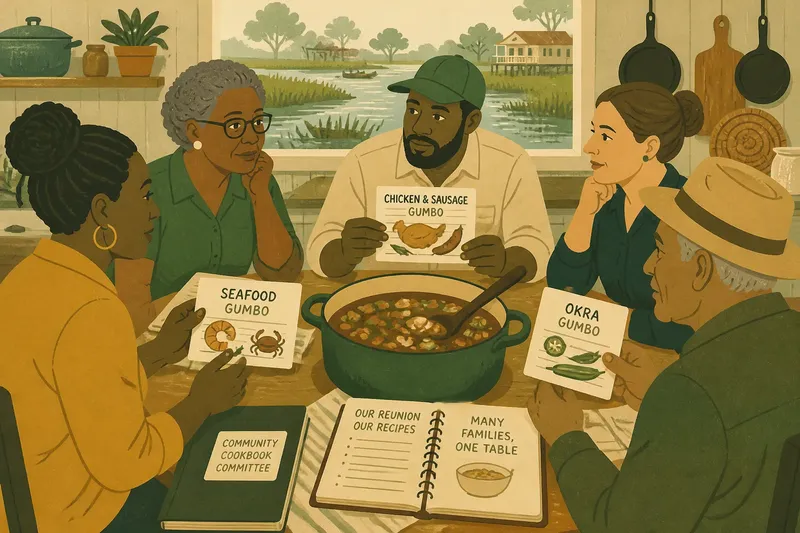
Imagine a community cookbook committee in an invented Gulf Coast town choosing one recipe to represent a local reunion table. Its members settle on gumbo, a dish with a strong regional reputation, and discover that agreeing on the name is easier than agreeing on the bowl. This imagined situation shows what a recipe can represent, what it cannot, and how to describe food traditions without flattening them.
A cookbook committee listens
The committee begins with a familiar ambition: find the version most people recognise, write it down clearly and print it as the town’s gumbo. One member brings a recipe with chicken and sausage; another describes seafood gumbo; a third says their family makes a version with okra, while a neighbour’s roux-dark pot contains no okra at all.
At first, these differences seem like obstacles to a tidy page. The committee tries to settle them with questions such as which protein is correct, whether tomatoes belong, and how dark the roux should be. But every answer narrows the story. A cook might use what is available, follow a relative’s method, or make a different pot for a different occasion. A recipe is not an abstract regional rule; it records decisions made in particular kitchens.
The committee’s first useful choice is to stop treating disagreement as a vote on authenticity. Instead, it asks each contributor to describe the dish they actually make: what goes into it, what gives it its character, and when it appears at the table.
What one name conceals
Regional dish names gather many versions under a familiar label. That shared name matters: it gives people a way to recognise a food, talk about it and pass it along. Yet the label can conceal differences in ingredients, texture, technique and meaning.
Gumbo makes the point plainly. A roux may be pale or deeply browned; a cook may build the pot around seafood, poultry, sausage or some combination. Okra or filé may appear, but households do not all use the same thickener or sequence. Ingredients and customs vary within Louisiana and across the broader Gulf South, too. The word “gumbo” does not erase those distinctions.
Nor does a dish’s reputation mean every household in a region makes it. Families have their own foodways, and people move, marry, work and share meals across community lines. A regional label describes a connection, not a requirement. A cook can belong to a place without making a particular dish, and a much-loved recipe can travel well beyond the place associated with it.
For the committee, the practical change is small but important: its page will present a community contribution, not a verdict on regional cooking.
Why recipes vary
Once the committee listens rather than ranks, contributors start naming the forces behind their choices. Some are ordinary constraints: what a shop carries, what is in the freezer, how many people are coming, or how much time the cook has. Others are preferences passed between relatives—how to season the pot, when to add an ingredient, or what consistency feels right.
Place matters, but not as a neat border around one fixed recipe. A coastal household may have easy access to seafood; another cook may be far from the coast or simply prefer chicken. Local crops, work patterns and family histories shape what becomes familiar. Even neighbours sharing a town can have different pantry habits and different memories of the same dish.
Cooking methods carry variation as well. One person may make a dark roux slowly, watching its colour and scent; another may use a different method suited to their routine. A recipe written for a community booklet should explain its own choices without implying that every alternative is a mistake.
Say the fictional committee receives two gumbo recipes, one built around seafood and one around chicken and sausage. It prints both with contributors’ notes: one is the version served at a family holiday gathering; the other is the cook’s usual pot when relatives visit. Readers can see how occasion and household shape the same named dish, without being asked to choose a definitive regional recipe.
How to describe a recipe fairly
The committee now has a writing problem, not a culinary contest. A recipe needs enough detail for someone else to understand it, while its introduction must avoid claiming more than the contributor knows. Specific language does that work better than grand statements.
- Check whose recipe it is. If the contributor can name its source, introduce it as “my aunt’s seafood gumbo”; if not, describe it as that contributor’s version rather than claiming a family history.
- Check which ingredients and methods appear. If the recipe uses okra or a dark roux, name those choices; if it does not, leave them out of the description rather than calling them essential.
- Check the occasion. If the contributor makes the dish for a gathering, include that context; if it is an everyday meal, say so instead of implying every version is for a celebration.
- Check whose memory is being shared. If the account is personal, write “In our house, we served it over rice”; if it makes a claim about everyone locally, ask for wider support or narrow the wording.
- Check whether other contributors offer different versions. If they do, place the recipes side by side; if they do not, present the available recipe as one contribution, not the town’s final word.
- Check that the introduction leaves room for variation. If it describes one cook’s choices, keep it; if it presents them as rules for the region, revise it to name the cook or household.
Imagine the committee receives a contributor’s card headed “Gumbo for our reunion”. The card names chicken and sausage, includes okra, and says the cook serves the pot over rice when relatives gather. The editor records those details, attributes the recipe to that contributor, and leaves out any claim that the ingredients define gumbo across the South. The result is a clear account of one household’s dish; the trade-off is that it makes no claim to be the only version readers might encounter.
These habits also make a recipe more useful. Readers can identify the elements that belong to one cook’s method, then decide what they want to carry into their own kitchens. There is no need to turn every family preference into a test of belonging.
Questions about Southern recipes?
Is there one authentic Southern version?
Authenticity makes more sense when tied to a particular cook, household or community than to the entire South. A version can be deeply rooted in its maker’s life without serving as a universal standard.
Why do recipes for one dish differ so much?
Ingredients, local availability, family habits, occasion and personal taste all shape a recipe. Cooks may share a dish’s name while making distinct choices about what goes into the pot and how it is prepared.
Can a restaurant recipe represent a whole region?
A restaurant can offer a memorable local version, but its menu reflects that kitchen’s choices. Treat it as one expression of a food tradition, not a complete account of how every household cooks.
How should I share a family recipe?
Give it a specific name, identify whose version it is and add context about when or how your family serves it. That honours the recipe without asking it to stand in for everyone else’s.
A better page for town
The fictional committee’s final page is not a compromise recipe assembled from competing ingredients. It presents two gumbo recipes side by side, each introduced as a contributor’s version, with a short note about the occasion and household behind it. Readers can see the shared name, the differences and the people attached to each pot.
That format serves the reunion cookbook better than a single authorised recipe would. It preserves detail rather than sanding it away, and it gives residents room to recognise their own experience without insisting that every neighbour share it. The committee has not solved which gumbo is most Southern; it has noticed that the question was too broad to answer fairly.
The one-recipe-fits-the-South myth can be tempting because a single page is easy to print and a single answer sounds decisive. But food traditions are carried by people, and people make choices in kitchens shaped by family, place and circumstance. When you describe a regional dish, name the version in front of you, then leave space for the versions you have not heard yet.
For a community cookbook, that careful wording gives the next cook a useful starting point and a reason to ask who else has a recipe to share.